A finite, timeless configuration ontology for physics: quantum probability derived as a counting theorem, Bell violation exhibited by counting, Schrödinger wavepacket dynamics computed by counting, and a labeled research program toward emergent time and geometry.
1. Overview
Configuration Realism (CR) begins from two established readings of established physics, and adds
one new step. The relativity of simultaneity, read ontically, yields a block universe: all events
exist, none privileged as present. The Wheeler–DeWitt constraint of canonical quantum
gravity, read at face value, eliminates fundamental temporal evolution. Together these give a
universe that does not evolve in time — but not, by themselves, a finite one. The new step
is this work’s: if the Born rule of quantum probability — among the most precisely
confirmed laws in physics — is also read ontically, its exponent a fact about the world
rather than a principle about observers’ credences, then, this work argues, outcome classes
must carry a canonical measure: they must be finite. Adding finiteness completes the ontology
— a timeless, finite configuration space in which information exists only as physical
records, probability is literal counting, and change is difference read along the refinement
ordering of an observer’s records, with time as the emergent coordinate that labels it.
From that ontology the Born exponent returns as a theorem, the Bell correlations are counted
at the quantum value, and Schrödinger wavepacket dynamics is derived from the
framework’s own move set — a derived core spanning probability and motion, from one
conserved quantity: the number of configurations — with the rest of physics as a stated
research program.
The work is organized by epistemic status, and every claim is classified — postulate, theorem,
verified, argument, conjecture, or open — in a ledger at the end of each paper. The derived
core is quantum probability and its dynamics. The population of an outcome class is proved to equal
\(N|\alpha|^2\) under named structural assumptions (the Born rule as a counting theorem). The
CHSH quantity assembled from ratios of integer counts reaches the quantum value
\(2\sqrt{2}\) — a finite ensemble of definite configurations is not a hidden-variable
model, and the papers show exactly why. And equipped with a local move set, counted populations
propagate as wavepackets: the effective mass is the inverse hopping rate of elementary
refinement, and the counted dynamics reproduces Schrödinger phenomenology with the number
of configurations conserved exactly at every stage. The conjectural program — causal structure,
Lorentzian geometry, geodesic dynamics, horizon thermodynamics as continuum limits of closure
geometry — is stated as such, with its open problems named.
2. What Differs from Standard Quantum Mechanics
Configuration Realism's predictions differ from those of continuum quantum mechanics, and the
differences are in principle testable. They come from finiteness: populations are integers, so
every probability is a ratio of counts, and Born statistics hold to \(O(1/N)\) rather than
exactly. Each difference below has a mechanism and an in-principle test; full statements and
the falsifiability analysis are in the
foundations paper. In brief:
Rational probabilities. Every probability is a ratio of two cardinalities,
hence a rational number; irrational Born values like \(\cos^2 15^\circ\) are approximated,
never attained, with error of order \(1/N\). Every precision test of quantum mechanics is,
on this framework, a lower-bound measurement of \(N\): conformity at precision \(\epsilon\)
implies \(N \gtrsim 1/\epsilon\). Resolving the offset outright requires
\(T \gtrsim N^2\) trials. Rendered in position space, the same prediction gives a counted
wavepacket finite support: the profile terminates exactly where the Born value crosses
\(1/N\), where the continuum Gaussian merely thins.
Two-sided Tsirelson deviations. The counted CHSH quantity differs from
\(2\sqrt{2}\) by \(O(1/N)\) — and, because counted correlators are rational, can land
above the Tsirelson bound, as it does in the enumeration. A statistically resolved
excess over \(2\sqrt 2\) is compatible with no continuum formulation of quantum mechanics.
Refinement-graded graininess. The deviation scale for an experiment is set
by the measured sector’s own unresolved multiplicity (environment multiplicity cancels
in the counting ratios), so the deviation from Born statistics is not a constant of the world
but grows with how completely the measured sector has been recorded — maximal near
closure saturation, the framework’s rendering of horizons. Because this is a predicted
relation rather than a single number, it is the framework’s genuine refutation
channel: where the multiplicity can be independently estimated, graininess must track
refinement, or the counting ontology is wrong. The record-relativity mechanism behind this
prediction has dynamical support: counting only at record-forming stages preserves the
\(O(1/N)\) family under propagation, while a stage-wise census would degrade it to
\(\sim N^{-0.6}\).
Logarithmic run-length bound. A stored \(k\)-run outcome sequence has
population \(\sim M_s\prod_i p_i\), which depopulates once \(k\) exceeds roughly
\(\log M_s\): a finite world supports literal-counting frequency statistics only over runs
shorter than the logarithm of its unresolved multiplicity.
Entropy caps. No record’s entropy exceeds the log of its class
population, and nothing exceeds \(\log|\Omega|\) — a native maximum-entropy statement,
aligning with the Bekenstein and de Sitter bounds that independently motivate finiteness.
3. Papers
Four papers, August 2026. Each paper is versioned independently. The three companion papers are self-contained; the foundations paper states the full framework and integrates them. All four papers are licensed CC BY 4.0.
The Born Exponent from Counting: Quantum Probability in a Finite Configuration Ontology
Abstract.
We prove that, in a finite and timeless configuration ontology with relational phase structure,
the population of an outcome class — the number of configurations compatible with an
observer’s records — equals \(N|\alpha|^2\), where \(N\) is the population of the
parent class and \(\alpha\) is the coherent sum of stage-relative configuration phases over the
outcome class. Because probability in this ontology is defined as a counting ratio,
the Born rule follows: quantum probability is quadratic because counting is quadratic. The
mathematical core of the argument is classical; the contribution is the premise: the conserved
quantity is a cardinality, not a normalization convention. Phase enters the ontology at two
levels: it attaches additively to degrees of freedom, making phase additivity a lemma rather
than an assumption; and it is relational, defined for each configuration relative to a stage of
an observer chain — we prove that no context-free phase assignment is consistent with the
existence of nontrivial devices. Given the linear composition of devices, the derivation
proceeds in two steps, each by contradiction. First, a population rule that is not a pure power
of \(|\alpha|\) contradicts the multiplicativity of counting for independent subsystems.
Second, an exponent other than two contradicts conservation of the number of configurations,
which holds automatically because a device stands between two stages whose records differ by no
outcome information and therefore share one fixed compatibility class. A necessity argument
shows that an ontic Born exponent requires canonically measurable — hence finite —
outcome classes; passing from populations to observed frequencies requires exactly one
explicitly stated typicality assumption, on which the value of the exponent does not depend.
All results are verified by literal enumeration in an explicit finite model with class
populations up to \(4.2\times10^6\), and finiteness yields falsifiable departures from
continuum quantum mechanics: every probability is rational, and Born statistics hold to
\(O(1/N)\).
CHSH by Counting: Bell Violation in a Finite Configuration Ontology
Abstract.
A finite ensemble of definite, equally real configurations looks like it must obey the Bell
inequalities: definite values, counted, are the textbook picture of a local hidden-variable
model. We show that the instinct fails, and exhibit the failure by literal enumeration. In the
finite, timeless configuration ontology of the companion papers — where probability is
counting, phase is stage-relative, and the population of an outcome class is proved to equal
\(N|\alpha|^2\) — the CHSH quantity assembled from ratios of integer counts reaches the
quantum value \(2\sqrt{2}\) to \(O(1/N)\); at \(N = 4.2\times 10^6\), counted
\(|S| = 2.8284267\). The instinct fails for three separable reasons, each with a counting
formulation. Structural exclusion — which configurations exist — is relative to the
instantiated measurement bases and fixes only the aligned-basis correlations. Configurations
bear outcome records only for the devices their correlation structure contains, so no
configuration answers two incompatible settings and, by Fine’s theorem, no Bell
inequality can be derived. And the skew-angle statistics are carried by the phase structure of
the class — the same cross terms that carry two-slit interference. A control run makes the mechanism visible: inserting a
sector record, the which-path analog, forces per-class summation, the cross terms never form,
and counted \(|S|\) falls below the local bound. Marginal counts are computed for each wing
from that wing’s structure alone, so the counting form of no-signaling holds by
construction and is tested exactly, including at small \(N\). On the no-go ledger the ontology
keeps locality and free settings; for the plain Bell scenario its operative escape is the
absence of counterfactual values, with the denial of absolute outcomes required only in
Wigner’s-friend extensions. One in-model prediction distinguishes the
framework from continuum quantum mechanics: \(\bigl||S| - 2\sqrt 2\bigr| = O(1/N)\), with the
residue’s scale robust and its sign conditional on the model’s integer-apportionment
rule, which is flagged as a postulate. This paper is a demonstration and a disentangling, not a
new theorem: given the companion results, the violation is guaranteed; what is shown is why a
counting ontology is entitled to it.
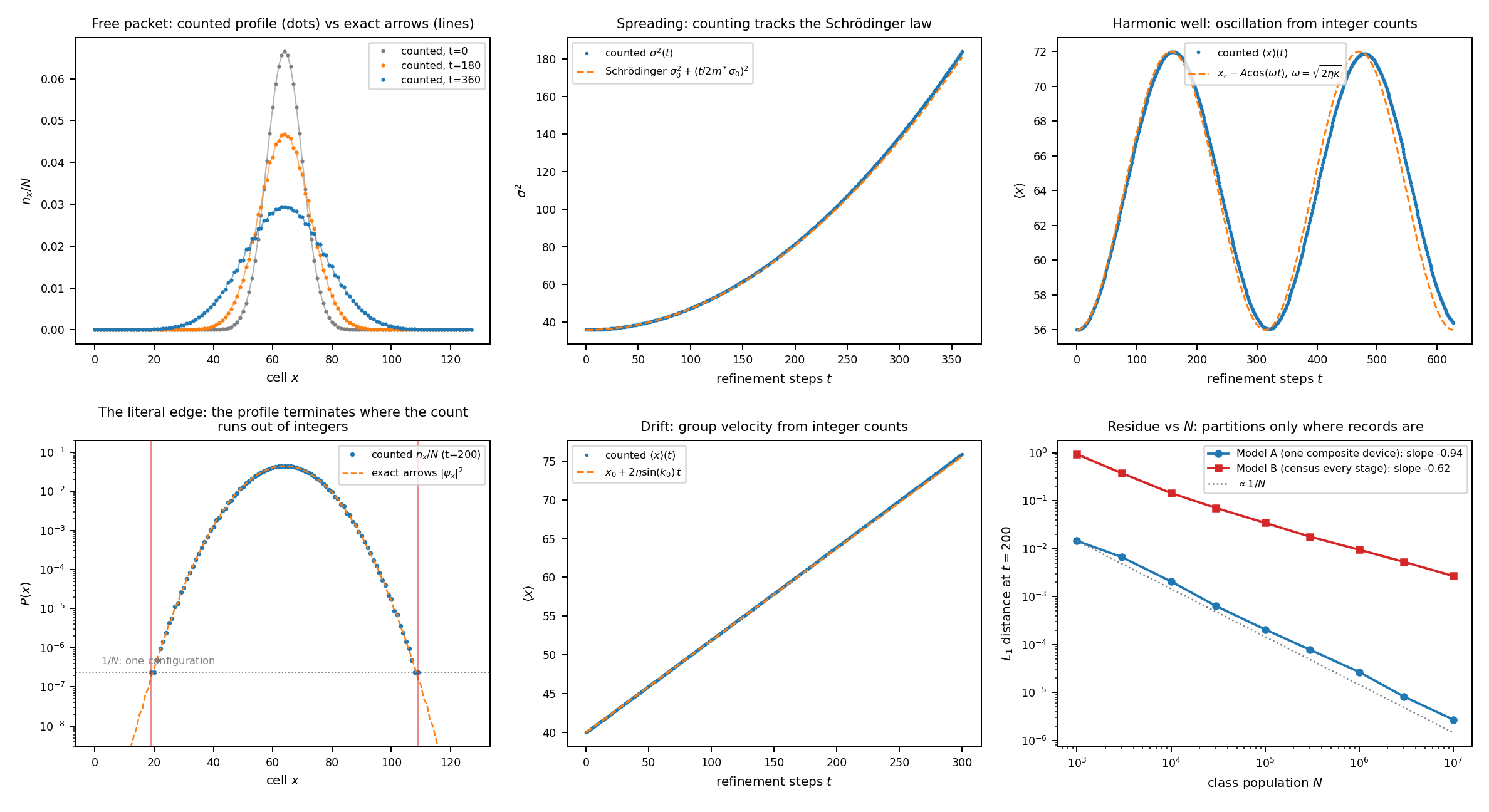
Schrödinger by Counting: Wavepacket Dynamics in a Finite Configuration Ontology
Abstract.
In a finite, timeless configuration space where probability is counting and the population of
an outcome class is proved to equal \(N|\alpha|^2\), we construct a refinement chain from
local devices — nearest-neighbour beamsplitters and per-cell phase increments, all on
the 3,600-value phase lattice of the companion models — and evolve wavepacket classes by
literal enumeration. The small-angle brickwork realizes the lattice Hamiltonian
\(H = -2\eta\cos k + V(x)\): the effective mass \(m^\ast = 1/(2\eta)\) is the inverse hopping
rate — mass as resistance to record restructuring, obtained from the move set rather
than posited — and the potential is a cell-dependent phase cost per closure step. Counted
populations reproduce the Schrödinger spreading law
\(\sigma^2(t) = \sigma_0^2 + (t/2m^\ast\sigma_0)^2\), the group velocity to seven significant
figures against the exact device chain, and harmonic oscillation at
\(\omega = \sqrt{2\eta\kappa}\), with \(\sum_x n_x = N\) exact at every stage — the
counting form of unitarity, tested exactly. Two findings go beyond agreement. First, the
counted packet has a literal edge: populations fall to one configuration and then to zero
exactly where the Born value crosses \(1/N\), so a counting world’s particle has finite
support where the continuum Gaussian merely thins — the rational-probability prediction
rendered in position space. Second, the ontology’s record-relative definition of classes
is load-bearing for dynamics: counting once at the measurement stage (the chain as one
composite device) yields residues of \(O(1/N)\), measured log–log slope \(-0.94\),
whereas imputing an integer census to unrecorded intermediate stages — partitions where
no records are — degrades the scaling to slope \(-0.62\) through the amplitude
granularity of few-configuration tail classes. A definitional clause changes dynamical
accuracy by a factor of order \(\sqrt{N}\). What is not shown is the formal continuum limit:
given [CS] the discrete effective dynamics is derived, with the same conditional status as
the companion theorems, and the passage to the continuum equation remains the
framework’s open problem. The cell structure is a named input [CS]
— but not a foreign one: its three clauses are the discrete shadow of the
framework’s own emergent-space program, and we locate each, finding that a preferred
partition is what the stability criterion already selects, that adjacency is what the
elementary refinement move set already supplies, and that only the graph’s large-scale
regularity — together with an assumed uniformity of hopping rate, which is a flatness
assumption — remains open. Reading the cells as emergent space has an immediate
consequence: the construction’s maximal group velocity is one instance of the
framework’s conjectured invariant speed, computed rather than posited, since a single
elementary move defines both the refinement step and the spatial adjacency. Relaxing
uniformity — a position-dependent hopping rate, hence a position-dependent effective
mass — is the discrete form of curvature, and is the natural next model.
Configuration Realism: Foundations
August 2026 — postulates, the derived core, consequences, and conjectures, with the status of every claim tabulated
Abstract.
Configuration Realism (CR) is a physical ontology consisting of a finite, timeless
configuration space. Each configuration is a complete arrangement of fundamental degrees of
freedom; none evolves; phase attaches additively to degrees of freedom and is defined
relationally, relative to a stage of an observer chain. Information exists only as finite,
lossy physical records. Each record defines a compatibility class, the configurations it
cannot distinguish, and probability is defined as counting over these classes. The
framework’s derived core is proved and computed in three companion papers under named
structural assumptions. The population of an outcome class equals \(N|\alpha|^2\): the Born
rule as a theorem, with the frequency reading consuming exactly one typicality principle. The
CHSH quantity assembled from integer counts reaches \(2\sqrt{2}\) to \(O(1/N)\), the ontology
giving up counterfactual definiteness in the plain Bell scenario — and the absoluteness
of outcomes where Wigner’s-friend extensions demand it — rather than locality or
free settings. And equipped with a local move set, counted populations propagate as
wavepackets: the effective mass is the inverse hopping rate of elementary refinement, the
potential is a cell-dependent phase cost, and the counted dynamics reproduces
Schrödinger phenomenology with the number of configurations conserved exactly at every
stage. Around this core, closure laws order records by refinement. Observers are chains of
record-bearing stages; change is difference read along a refinement chain; time is the
emergent coordinate that labels it; and closure distance, accumulating in discrete quanta,
measures the restructuring refinement requires. Direct consequences follow for entropy and
the arrow of time, for the classical limit, and for objectivity as redundancy. The remainder
is a labeled research program: causal structure, Lorentzian geometry, geodesic dynamics, and
horizon thermodynamics as conjectured continuum limits of closure geometry, with the
constructions that would establish them stated as open problems. A dedicated section collects
the framework’s distinctive predictions — the \(O(1/N)\) family separating a
counting world from continuum quantum mechanics — each with its mechanism and
in-principle test. Every claim in the paper is tabulated with its status: postulate, theorem,
verified, argument, conjecture, or open.
4. Postulates
The framework rests on six postulates. Condensed statements follow; the full statements, with their status classifications, are in the foundations paper.
Postulate 1 — Timeless Finite Configuration Space with Relational Phase
Physical reality consists of a timeless configuration space \(\Omega\) with \(|\Omega| < \infty\).
Each configuration \(\omega \in \Omega\) specifies a complete arrangement of fundamental degrees of freedom. Configurations do not evolve, and none is created or destroyed.
Phase enters at two levels. Phase attaches to degrees of freedom: a configuration’s phase content composes additively from its independent parts (making phase additivity a lemma, not an assumption). Phase is relational: what exists is the phase of a configuration relative to a stage of an observer chain, \(S_r(\omega)\), accumulated along the refinement ordering; only phase differences within a stage are physical. A context-free per-configuration phase is provably inconsistent with the existence of nontrivial devices.
Postulate 2 — Finite Physical Records
Information exists only in the form of physical records: finite arrangements of degrees of freedom whose structure corresponds to correlations.
Perfect representation of correlations would require reproducing the correlated structure itself; records are therefore necessarily lossy.
Postulate 3 — Compatibility Classes
Each record \(r\) defines its compatibility class,
\[
\Omega_r = \{\, \omega \in \Omega \mid \omega \text{ is compatible with the correlations encoded in } r \,\},
\]
the configurations indistinguishable with respect to \(r\).
For a fixed record-bearing subsystem, the classes of its distinguishable record states partition \(\Omega\); classes borne by different subsystems generally overlap.
Postulate 4 — Closure Laws, Elementary Refinements, and Closure Distance
Correlations may imply additional correlations. Closure laws express this implication structure, order records by refinement, \(r_1 \preceq r_2\), and license a discrete family of elementary refinements: single-step restructurings, each encoding one minimal increment of correlational content.
Closure distance is defined, not separately postulated: \(d_c(r \to r')\) is the minimal number of elementary refinements carrying \(r\) to \(r'\) (scaled by \(\delta_c\)), infinite if no admissible chain exists. Its quasi-metric properties follow from the definition — the empty chain gives \(d_c(r \to r) = 0\), concatenation gives the directed triangle inequality — and refinement is directional. Structurally: insertion-only edit distance on the closure-law-constrained refinement graph.
Postulate 5 — Closure Quantum
Every elementary refinement encodes the same minimal distinguishable increment of correlation-encoding capacity, the closure quantum \(\delta_c\); closure distance therefore accumulates as \(d_c = N_{\mathrm{steps}}\,\delta_c\).
Nothing fundamental is infinitesimal; all continuum descriptions of closure geometry are coarse-grained.
Postulate 6 — Observer Chains, Closure Dynamics, and Measurement
An observer stage is a structured subsystem whose internal degrees of freedom include records; observers are defined purely structurally, with no assumption of consciousness or experience.
Configurations exist that contain structurally related observer stages whose records are ordered by refinement: observer chains exist. “The observer” is the identification across a chain — a family of subsystems of distinct configurations connected by closure structure alone.
Change is difference read along a refinement ordering; time is the emergent coordinate labeling it; a measurement is closure dynamics in which the compatibility class defined by the observer’s records changes.
5. Toy Models & Results
Every derived claim is checked by literal enumeration in explicit finite models: configurations
are materialized as lists, probabilities are computed by counting elements, the counting rule was
fixed before any case was computed, and device parameters enter only through correlation
structure — never as weights on configurations. Phases are stage-relative throughout,
exactly as Postulate 1 prescribes. All figures below are generated by the scripts in
Code & Data.
Born by counting
code/cr_toy_model.py
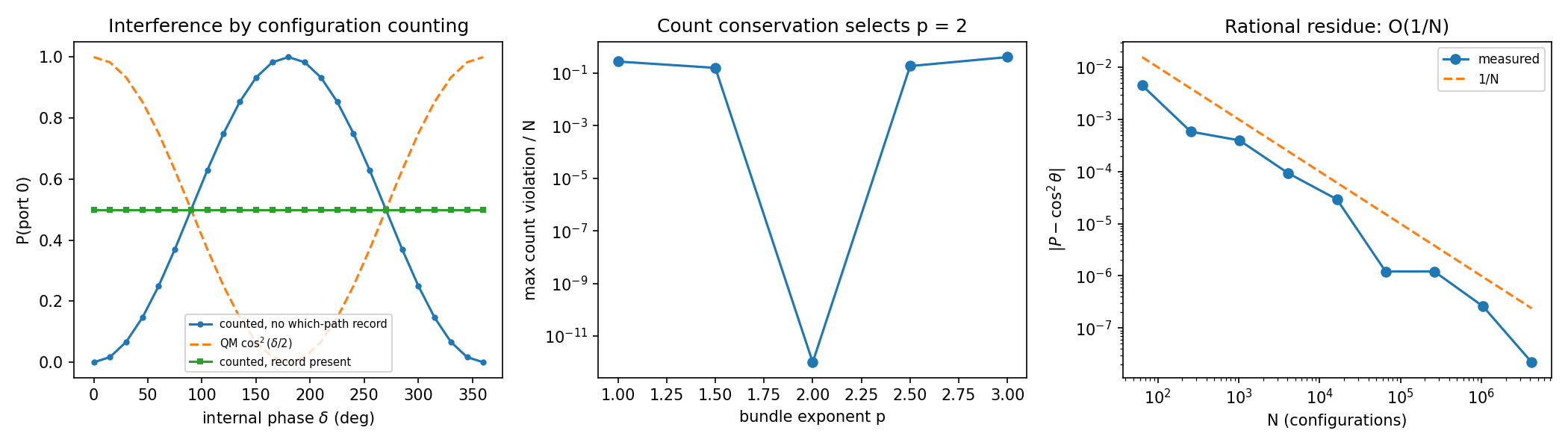
Six tests of the counting rule \(n_i = N|\alpha_i|^2\) at class populations up to
\(4.2\times10^6\). Unequal beamsplitters: counted probability matches \(\cos^2\theta\) to
\(\sim 3\times10^{-7}\) (at \(\theta = 15^\circ\): 933,013 of \(10^6\) configurations against
0.9330127). Mach–Zehnder interference: fringe visibility 1.0000 by counting, tracking
\(\cos^2(\delta/2)\); inserting a which-path record drives visibility to 0.0000.
Conditionalization: measurement update as literal elimination reproduces conditional Born
values to \(5\times10^{-7}\). Three-outcome splitters: same law, no new ingredients. Exponent
uniqueness: with the scale calibrated once and held fixed, count conservation is violated by
15–41% for \(p \in \{1, 1.5, 2.5, 3\}\) and satisfied exactly at \(p = 2\) —
finiteness plus linearity force Born’s square. Rational residue: the deviation from exact
Born statistics scales as \(O(1/N)\), measured log–log slope \(-1.06\).
Interference by counting, with and without a which-path record (left); count conservation selecting \(p=2\) (center); \(O(1/N)\) residue (right).
Multiplicativity and entanglement
code/step1_multiplicativity.py
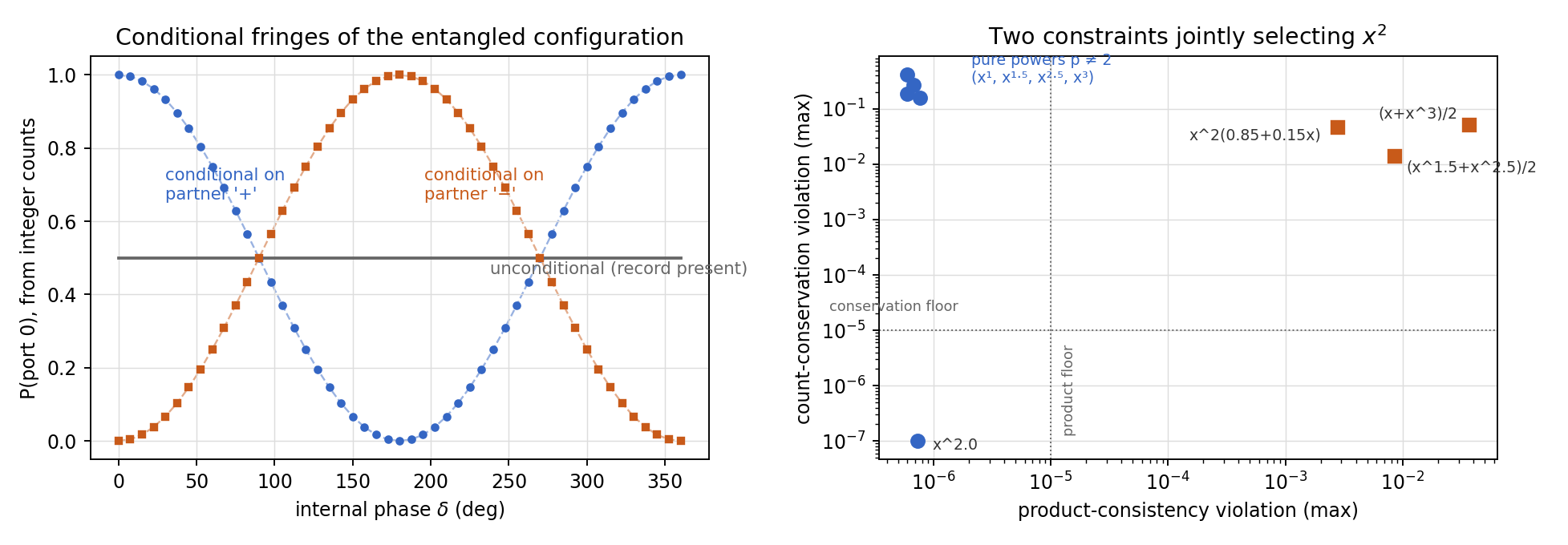
The two constraints of the Born derivation, separated numerically: product consistency across
independent subsystems eliminates every monotone non-power rule (violations at the
\(10^{-2}\) level), while count conservation eliminates every power but the square — the
two theorems of the derivation, each doing exactly its own work. Entanglement: multiplicativity
fails for a Bell-type state, as the derivation requires (its factorization lemma presupposes
independence); the entangled partner acts as a which-path record, driving unconditional fringe
visibility to 0.0000; conjugate-basis measurement restores conditional fringes at visibility
1.0000 with opposite phases — the quantum eraser, by counting.
Conditional fringes of the entangled configuration (left); product consistency and conservation jointly selecting \(x^2\) (right).
Stability, einselection, and duality
code/step4_stability.py
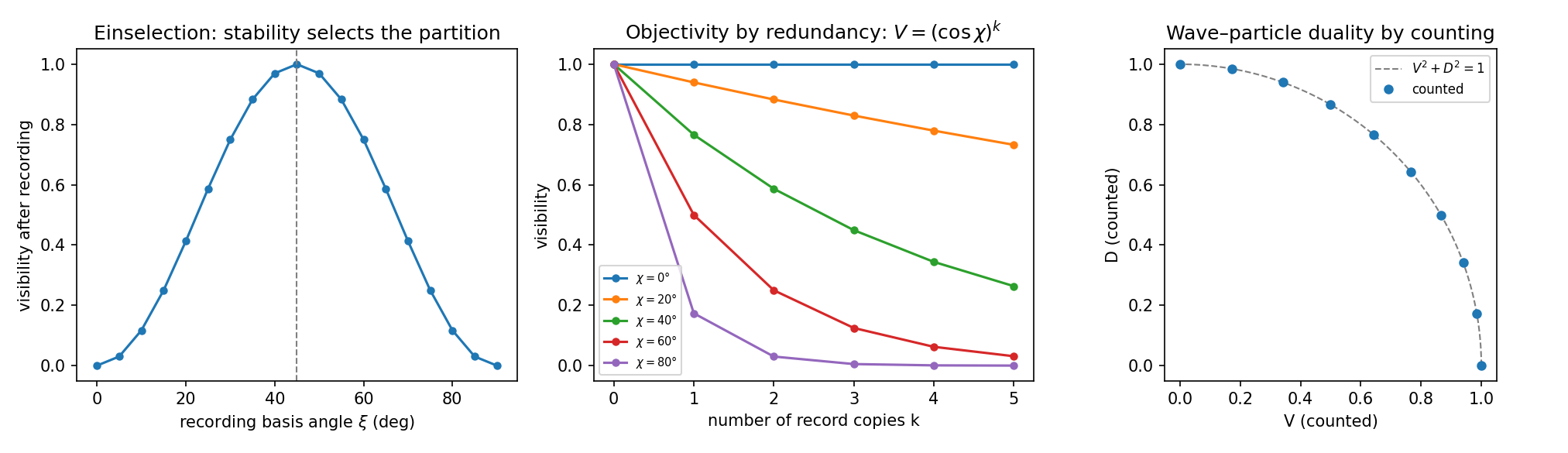
The domain of the Born rule, fixed by which partitions can carry stable records. Einselection
by counting: recording in a basis rotated by \(\xi\) from the coherent bundle disturbs
downstream fringes except at the bundle-aligned basis (\(\xi = 45^\circ\)), where recording
costs nothing — the stability criterion selects the recordable partition, not the
modeler. Objectivity as redundancy: \(k\) partial records at coupling strength \(\chi\) leave
visibility \((\cos\chi)^k\), verified at every grid point — stable records copy freely,
cross-cutting records degrade geometrically. Wave–particle duality: visibility and
distinguishability, both obtained from integer counts, satisfy \(V^2 + D^2 = 1\) with maximum
deviation \(3\times10^{-4}\).
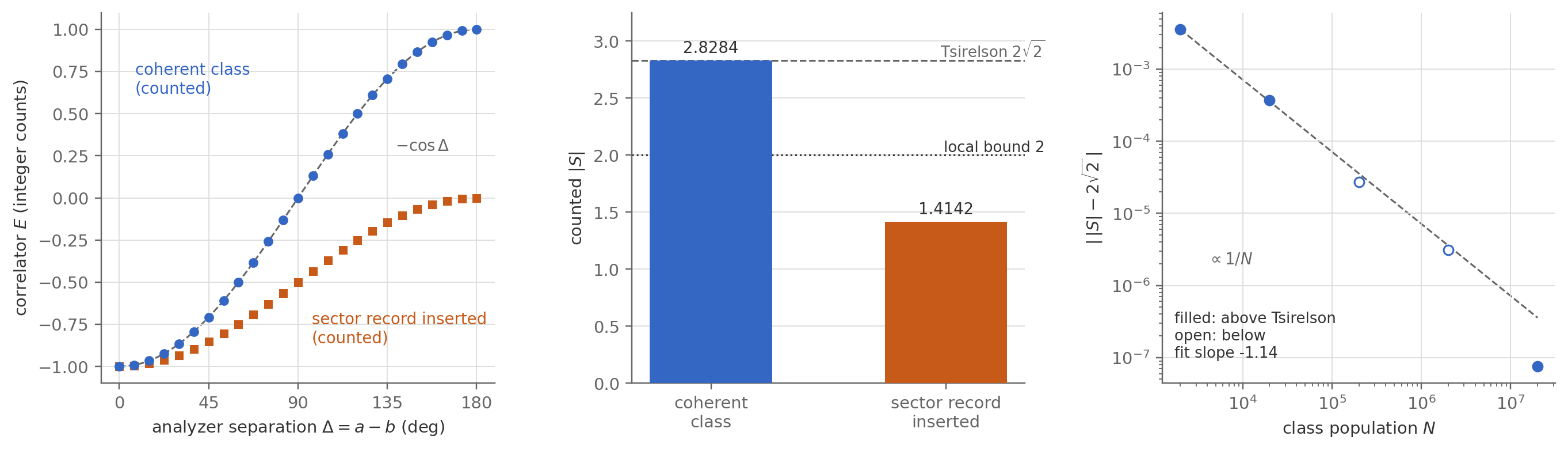
Bell violation from a finite list of definite configurations. Aligned analyzers: same-spin
count exactly 0 of 4,200,000 — structural exclusion, in its basis. Skew analyzers: the
“forbidden” same-spin configurations exist, 307,538 per class against a Born value
of 307,537.9 — exclusion is basis-relative. CHSH at the standard settings:
\(|S| = 2.8284267\) from integer counts, within \(5\times10^{-7}\) of the quantum value
\(2\sqrt 2\). Control run: inserting a sector record (the which-path analog) forces per-class
summation and \(|S|\) falls to 1.4142, below the local bound — the entire violation is
carried by the cross terms the record removes. No-signaling by counting: each wing’s
marginal counts are computed from that wing’s structure alone and are exactly independent
of the other wing’s setting, tested down to \(N = 20\). The residue
\(\bigl||S| - 2\sqrt2\bigr|\) scales as \(O(1/N)\), landing on both sides of the Tsirelson
bound — the scale robust, the sign conditional on the model’s integer-apportionment
rule.
Counted correlators track \(-\cos\Delta\) for the coherent class and the common-cause form for the recorded control (left); counted \(|S|\) against the local and Tsirelson bounds (center); \(O(1/N)\) residue, both sides of Tsirelson (right).
Schrödinger by counting
code/schrodinger_by_counting.py
Wavepacket dynamics from a brickwork of nearest-neighbour beamsplitters and per-cell phase
increments, on a 128-cell chain with \(N = 4.2\times10^6\). Free spreading: counted variance
tracks the Schrödinger law \(\sigma_0^2 + (t/2m^\ast\sigma_0)^2\), with the exact device
chain matched to \(L_1 = 8.6\times10^{-6}\). Drift: counted group velocity matches the exact
chain to seven significant figures. Harmonic well: counted \(\langle x\rangle(t)\) oscillates
at \(\omega = \sqrt{2\eta\kappa}\) over two full periods. Counting unitarity:
\(\sum_x n_x = N\) exact at every stage, never violated. The literal edge: the counted
profile has finite support, terminating at population 1 exactly where the continuum tail
crosses \(1/N\). Residue scaling: counting once at the record-forming measurement stage
(Model A) gives \(O(1/N)\) residues, log–log slope \(-0.94\); imputing an integer
census to unrecorded intermediate stages (Model B) degrades the slope to \(-0.62\) —
the record-relative definition of classes changes dynamical accuracy by a factor of order
\(\sqrt N\).
Counted free-packet profiles against exact arrows, the spreading law, and harmonic oscillation (top); the literal edge, counted drift, and residue scaling for Model A (slope \(-0.94\)) against Model B (slope \(-0.62\)) (bottom).
6. Code & Data
All scripts are plain Python (NumPy; Matplotlib for figures) and run in seconds. Each prints its
tests and verdicts to the console; the model scripts regenerate their figures, and the
Schrödinger suite writes its raw numbers to a results file. The code suite is licensed
MIT, with authorship and license headers in every script.
cr_toy_model.py — Born by counting: splits, interference, decoherence, conditionalization, exponent uniqueness, \(O(1/N)\) scaling.
step1_multiplicativity.py — product consistency vs. conservation; entanglement and the quantum eraser by counting.
step4_stability.py — einselection, redundancy \((\cos\chi)^k\), and \(V^2+D^2=1\) from integer counts.
chsh_by_counting.py — CHSH at \(2\sqrt 2\) by counting; sector-record control; exact no-signaling; residue scaling.
schrodinger_by_counting.py — wavepacket dynamics by counting: spreading, drift, harmonic oscillation, the literal edge, Model A vs. Model B residue scaling; writes schrodinger_by_counting_results.json.
Author
Russell Tillitt
Independent Researcher
San Francisco, California
Acknowledgments
The author used large language models (OpenAI ChatGPT; Anthropic Claude) to assist in the preparation of this work. The author takes full responsibility for all content.
Suggested Citation
Tillitt, R. (2026). The Born Exponent from Counting: Quantum Probability in a Finite Configuration Ontology. Zenodo. doi:10.5281/zenodo.21523492
Tillitt, R. (2026). CHSH by Counting: Bell Violation in a Finite Configuration Ontology. Zenodo. doi:10.5281/zenodo.21523901
Tillitt, R. (2026). Schrödinger by Counting: Wavepacket Dynamics in a Finite Configuration Ontology. Zenodo. doi:10.5281/zenodo.21842637
Tillitt, R. (2026). Configuration Realism: Foundations. Zenodo. doi:10.5281/zenodo.21523984
Revision History
Release 2.0 — August 2026: fourth paper added, Schrödinger by Counting — wavepacket dynamics computed by enumeration under a named cell structure [CS]. Foundations paper retitled Configuration Realism: Foundations, with the dynamics results integrated into the derived core (new Part II section), the invariant-speed conjecture upgraded by a computed instance, and the principle-theory framing carried throughout. Editorial revision across all four papers. Code suite licensed MIT, with authorship and license headers added to every script.
Release 1.0 — July 2026: publication release. Abstracts revised; internal draft labels retired — each paper is now versioned independently, starting at v1; papers licensed CC BY 4.0. Release 1.0 comprises the Born exponent paper v1, the CHSH paper v1, the foundations paper v1, and the code suite.
Version 0.2 — July 2026: three papers (Born exponent, CHSH by counting, foundations), toy models and results, postulates updated to the relational-phase formulation.
Version 0.1 — March 2026: initial postulates published at this site under the name Configuration Realism.
Origin — 2024, possibly earlier: the framework was first developed in written form under the name Quantum Eternalism. The earliest dated summary (private correspondence, April 2024) already contains the core commitments: a timeless totality of all configurations, no evolution or branching, observation as change in an observer’s information state, interference among configurations shaping what is observed, and an emergent arrow of time — developed in explicit relation to Barbour’s timeless mechanics and the Wheeler–DeWitt equation.